
An Interactive Demonstration of Scientific Product Thinking Using a Polyethylene Glycol Selection Tool
Selecting the right polyethylene glycol (PEG) is rarely straightforward. Molecular weight, functional group chemistry, polymer architecture, solubility, and application context all interact — and this information is typically scattered across vendor catalogs and datasheets.
👉🏽 Access the PEG Selection Tool here 👈🏽
The PEG Selector is a non-commercial MVP (Minimum Viable Product ) demonstrating how PEG selection and PEGylation decision-making can be streamlined through structured data, interactive filtering, and explainable logic. It focuses on core functionality and representative data to show how a full-scale scientific decision-support tool could work — without claiming to be exhaustive or definitive.
🎥 Watch a short demo of the PEG Selector Tool in action on YouTube here. In this video, I walk through the interactive filters, demonstrate how to select PEGs for biomaterials and biomedical research, and explain how the tool works.
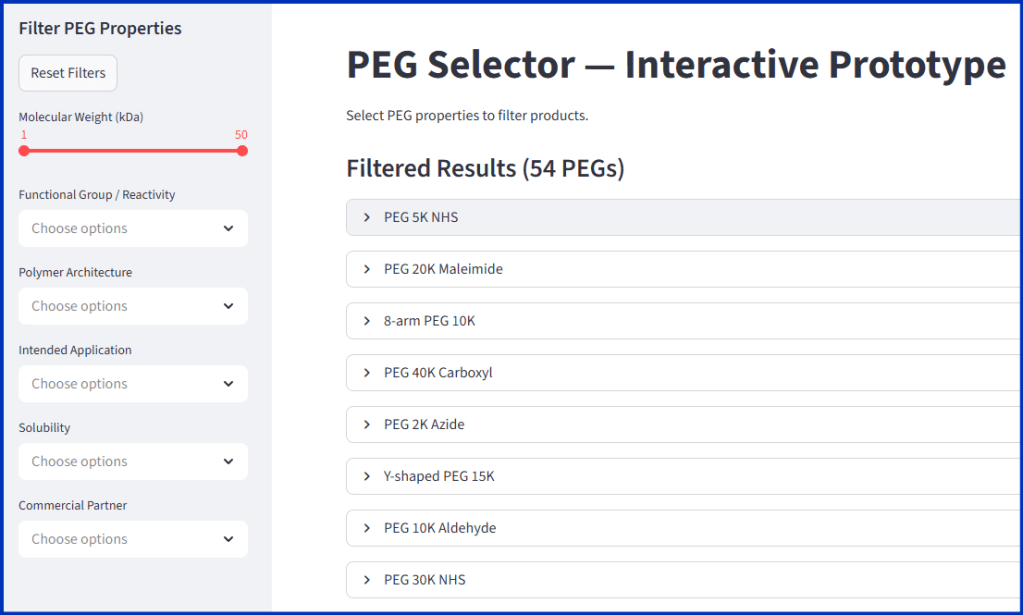
Screenshot of PEG Selector
This is not a commercial product — it’s a conceptual demonstration of how scientific workflows like PEG selection for biomaterials, drug delivery, and bioconjugation can be translated into intuitive, data-driven tools.
Intended Users & Research Context
This prototype is designed with early-stage and translational life science research in mind, where PEG selection is frequent, iterative, and often exploratory.
Intended users include:
- Life science researchers and scientists
- Translational and preclinical research teams
- Biomaterials and polymer scientists
- Protein engineering and bioconjugation researchers
- R&D professionals evaluating PEGs during feasibility or design stages
Representative research areas include:
- Protein PEGylation and bioconjugation workflows
- Drug delivery and formulation development
- Biomaterials and hydrogel design
- Surface modification and functional coatings
- Early-stage therapeutic and diagnostic development
The tool reflects how PEG selection typically occurs up‑funnel, before formal vendor engagement or procurement.
What This Prototype Demonstrates
The PEG Selector MVP showcases how publicly available PEG product information can be organized into a structured, user-driven PEG selection tool.
Key capabilities include:
- Multi-parameter filtering by molecular weight (slider-based selection)
- Filtering by functional group / reactivity (e.g., Amine, NHS ester, maleimide, etc.)
- Selection by polymer architecture (bifunctional, linear, or multi-arm)
- Filtering by solubility, intended application, and commercial partner
- Expandable product views for efficient access to detailed attributes
The emphasis is on clarity, explainability, and workflow alignment, rather than automation for its own sake.
Why PEG Selection Matters
PEG-based materials are foundational across PEGylation chemistry, drug delivery systems, biomaterials engineering, and surface chemistry. Despite their widespread use, PEG selection remains largely manual, experience-driven, and time-intensive.
When selection goes wrong — through mismatched molecular weight, incompatible functional groups, or poorly understood architecture — the consequences are tangible: failed formulations, wasted reagent costs, and delays in early-stage workflows that are already resource-constrained. Having a structured, explainable selection process reduces these risks before experimental work begins.
This prototype explores how structured data, interpretable selection rules, and thoughtful interaction design can reduce friction in early-stage PEG selection and biomaterials research — without obscuring the underlying assumptions or scientific judgment.
Data Sources and Commercial Context
The prototype references representative PEG products associated with well-known suppliers, including (but not limited to) Thermo Fisher Scientific, Sigma-Aldrich, and Avantor. All product attributes shown are realistic and broadly consistent with commercially available PEGs. However, the dataset was constructed specifically for demonstration purposes. Sample PEG products were defined first, and corresponding vendor URLs were added where publicly available information could be reasonably identified. As a result:
- Vendor links are public, navigational, and representative
- URLs may point to search pages or related product families
- Catalog-level accuracy is not the primary goal of this MVP
The focus is on PEG selection logic, structure, and user experience — not vendor catalog completeness or procurement accuracy.
Explore the Interactive Prototype
You can access the latest version of the Interactive PEG Selector Prototype (hosted on Streamlit Cloud) here 👇🏽
https://peg-selector-v5-romeshcollins.streamlit.app/
This version includes advanced filtering, ranked recommendations, rule-based suggestions, expandable product details (including representative URLs), and CSV export functionality.
🚨 Disclaimer
This tool is an independent, non-commercial MVP created solely for demonstration and educational purposes. All product information is derived from publicly available sources. Product names and attributes are used illustratively, and vendor URLs are representative and navigational in nature. URLs may not correspond exactly to every listed product. No affiliation, endorsement, sponsorship, or partnership with Thermo Fisher Scientific, Sigma-Aldrich, Avantor, or any other commercial entity is implied. This tool should not be used as a substitute for experimental validation, regulatory assessment, or procurement decisions.
Final Note
This prototype reflects how I approach scientific data, product thinking, and user-centered design—translating complex PEG selection and PEGylation decisions into practical, transparent tools built around real research workflows.

