
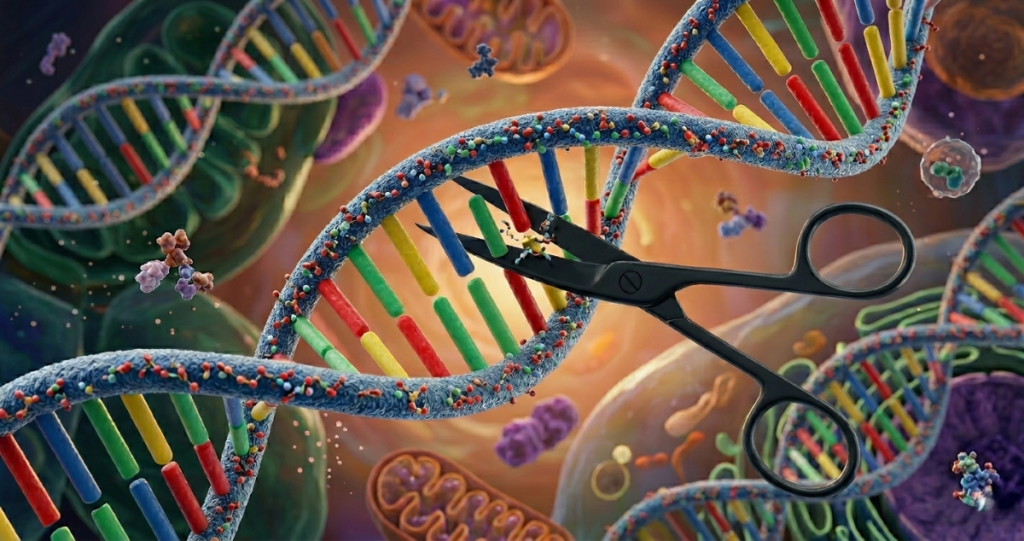
CRISPR has graduated from scientific breakthrough to clinical and commercial reality. Its significance extends beyond DNA editing — it represents a programmable approach to modifying biological systems at their source.
CRISPR — short for Clustered Regularly Interspaced Short Palindromic Repeats — earned Jennifer Doudna and Emmanuelle Charpentier the 2020 Nobel Prize in Chemistry for adapting a bacterial immune defense mechanism into a precise genome editing tool. The system pairs a guide RNA (which locates the target DNA sequence) with the Cas9 enzyme (the molecular scissors that execute the cut), enabling researchers to add, remove, or replace specific DNA sequences with remarkable precision and control.
The discussion has rightfully expanded beyond this core mechanism. The pivotal question is no longer CRISPR’s technical feasibility — it is whether the technology can be translated into safe, scalable therapies that health systems can realistically deliver and sustain.
The Clinical Inflection Point
CRISPR crossed from promise to proof with the FDA approval of Casgevy (CRISPR Therapeutics/Vertex) in December 2023 — the first approved CRISPR-based therapy, indicated for:
- Sickle cell disease (SCD) in patients with recurrent vaso-occlusive crises
- Transfusion-dependent beta-thalassemia (TDT)
This ex vivo autologous stem cell therapy edits patients’ hematopoietic stem cells outside the body to boost fetal hemoglobin production, reducing sickling crises and transfusion burden.
This approval reframed the conversation entirely. CRISPR is now evaluated not just for scientific elegance, but for manufacturability, operational feasibility, and economic viability within real-world healthcare systems.
The Platform Potential
CRISPR’s greatest promise lies in addressing disease at its biological source — moving beyond symptom management toward interventions that modify underlying pathology. This potential spans both medicine (genetic diseases) and biotechnology (cell engineering, research acceleration).
The current pipeline reflects active momentum as of 2026:
- NTLA-2001 (Intellia Therapeutics): In Phase I/II clinical development for transthyretin amyloidosis (ATTR), with single-dose intravenous administration demonstrating substantial and sustained reductions in target protein levels
- Next-generation blood disorder programs: Building on Casgevy’s ex vivo success, with multiple mid- to late-stage programs targeting SCD/TDT variants and other hemoglobinopathies
- CTX110 (CRISPR Therapeutics): An allogeneic (off-the-shelf) CAR-T therapy in Phase I/II for CD19+ B-cell lymphomas
- EDIT-101 (Editas Medicine): Subretinal delivery for Leber congenital amaurosis type 10 (LCA10) in Phase I/II
These programs test whether CRISPR can scale beyond rare-disease proof-of-concept into broader therapeutic franchises — where delivery innovation and commercial execution become decisive factors.
Modality Selection: Choosing the Right Therapeutic Approach
CRISPR operates within a broader ecosystem of gene-modifying and gene-regulating technologies. These include next-generation editing approaches such as base editing and prime editing, as well as RNA-based modalities — small interfering RNA (siRNA) and antisense oligonucleotides (ASOs) — which modulate gene expression without permanently altering DNA.
Each modality suits different biological and clinical contexts:
- CRISPR (gene editing): Best suited for permanent correction of monogenic diseases, particularly in ex vivo settings where delivery and safety can be tightly controlled. Key applications include sickle cell disease, transfusion-dependent beta-thalassemia, and Duchenne muscular dystrophy.
- Base and prime editing: Offer higher precision without double-strand DNA breaks — advantageous for correcting single-point mutations where minimizing genomic disruption is critical. Relevant for certain hemoglobinopathies, cystic fibrosis (CFTR mutations), and familial hypercholesterolemia.
- siRNA and ASOs (gene silencing/regulation): Better suited for reversible or tunable modulation of gene expression, particularly in liver-targeted diseases such as familial hypercholesterolemia, transthyretin amyloidosis, and spinal muscular atrophy — where repeated dosing is feasible and permanent genome alteration may introduce unnecessary risk.
The strategic question is no longer whether CRISPR is inherently superior — but which modality is best matched to a given disease, target tissue, and therapeutic objective.
The Technical Constraints
CRISPR’s power comes with real tradeoffs. Off-target editing, delivery efficiency, immune response, and long-term safety remain central challenges. Even rare unintended edits carry potential therapeutic consequences, and in vivo delivery must reach the target tissue at the correct dose without inducing toxicity. Durability of editing effect and long-term follow-up data remain under active evaluation. Many programs may ultimately fail not due to lack of biological efficacy, but due to limitations in delivery, safety profile, or sustained effect — the true engineering challenge lies in translating elegant molecular tools into reliable interventions within living systems.
The Commercial Imperative
CRISPR therapies are far more than molecules. Casgevy’s treatment pathway — encompassing cell collection, specialized manufacturing, conditioning chemotherapy, infusion, and post-treatment monitoring — exemplifies the multi-step, resource-intensive workflows that define scalability challenges for gene-editing therapies. Each step requires precise coordination, specialized infrastructure, and trained personnel, making operational execution as critical as molecular design.
Building robust manufacturing capacity, site-of-care readiness, and patient access networks will be essential to bring these therapies to scale. Success will favor companies capable of mastering the entire product lifecycle: from target selection and delivery innovation to manufacturing scale-up, regulatory navigation, and market access strategy. In this context, CRISPR is as much a product strategy challenge as it is a scientific one — where integrated capabilities across biology, engineering, and operations determine who can deliver transformative therapies reliably and sustainably.
Ethical Considerations
Equitable access, germline editing boundaries, and responsible innovation are not peripheral concerns — they are foundational to earning durable public and regulatory trust. Ethical governance, transparent clinical protocols, and ongoing engagement with patients, clinicians, and research communities ensure that transformative technologies are developed responsibly and applied safely. For CRISPR and other next-generation therapeutics, credibility with stakeholders determines long-term adoption and public confidence as much as technical performance does.
The Strategic Convergence
CRISPR exemplifies the convergence of deep biological insight with sophisticated product strategy and operational execution. The field signals a broader shift in life sciences: success will depend not on scientific discovery alone, but on the ability to translate complex biology into clinically practical, commercially sustainable therapies.
The differentiator will not be who edits genes most precisely — but who builds integrated capabilities across science, manufacturing, regulation, and commercialization to deliver those therapies at scale. Those who master this convergence will not just participate in the future of medicine; they will define it.
References
- Collins, R. (2024). Genetic scissors: How CRISPR is revolutionizing medicine and biotechnology. LinkedIn Pulse.
- Broad Institute. (2015). CRISPR timeline. Broad Institute of MIT and Harvard.
- U.S. Food and Drug Administration. (2023). FDA approves first gene therapies to treat patients with sickle cell disease.
- U.S. Food and Drug Administration. (2023). CASGEVY: Summary basis for regulatory action.
- U.S. Food and Drug Administration. (2023). CASGEVY. U.S. Food and Drug Administration.
- Health Canada. (2023). Summary basis of decision for Casgevy.
- Innovative Genomics Institute. (2025). CRISPR timeline and clinical trials: 2025 update. University of California, Berkeley.
- Innovative Genomics Institute. (2024). CRISPR and ethics: An overview. University of California, Berkeley.
- Jinek, M., Chylinski, K., Fonfara, I., Hauer, M., Doudna, J. A., & Charpentier, E. (2012). A programmable dual-RNA–guided DNA endonuclease in adaptive bacterial immunity. Science, 337(6096), 816–821.
- Komor, A. C., Kim, Y. B., Packer, M. S., Zuris, J. A., & Liu, D. R. (2016). Programmable editing of a target base in genomic DNA without double-stranded DNA cleavage. Nature, 533(7603), 420–424.
- Anzalone, A. V., Randolph, P. B., Davis, J. R., Sousa, A. A., Koblan, L. W., Levy, J. M., et al. (2019). Search-and-replace genome editing without double-strand breaks or donor DNA. Nature, 576(7785), 149–157.
- Roberts, T. C., Langer, R., & Wood, M. J. A. (2020). Advances in oligonucleotide drug delivery. Nature Reviews Drug Discovery, 19(10), 673–694.
- Adams, D., Gonzalez-Duarte, A., O’Riordan, W. D., Yang, C. C., Ueda, M., Kristen, A. V., et al. (2018). Patisiran, an RNAi therapeutic, for hereditary transthyretin amyloidosis. New England Journal of Medicine, 379(1), 11–21.
- Crooke, S. T. (2017). Molecular mechanisms of antisense oligonucleotides. Nucleic Acid Therapeutics, 27(2), 70–77.
- Deloitte. (2024). Challenges in the emerging cell therapy industry. Deloitte Insights.
- McKinsey & Company. (2024). McKinsey insights on cell and gene therapy. McKinsey & Company.
- Frangoul, H., Altshuler, D., Cappellini, M. D., Chen, Y. S., Domm, J., Eustace, B. K., et al. (2021). CRISPR-Cas9 gene editing for sickle cell disease and β-thalassemia. New England Journal of Medicine, 384(3), 252–260.
- Gillmore, J. D., Gane, E., Taubel, J., Kao, J., Fontana, M., Maitland, M. L., et al. (2021). CRISPR-Cas9 in vivo gene editing for transthyretin amyloidosis. New England Journal of Medicine, 385(6), 493–502.
- Maeder, M. L., Stefanidakis, M., Wilson, C. J., Baral, R., Barrera, L. A., Bounoutas, G. S., et al. (2019). Development of a gene-editing approach to restore vision loss in Leber congenital amaurosis type 10. Nature Medicine, 25(2), 229–233.


